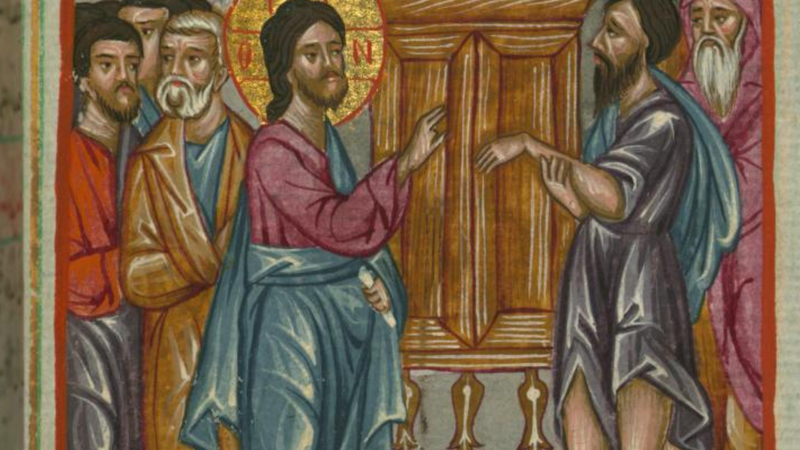
A sermon preached by the Reverend Canon Dr. David Anderson, at St. Jude’s Church, Oakville on Wednesday, January 21, 2026, Feria in Epiphanytide. Title: ‘Stretch Our Your Hand.’ Text: Mark 3:1–6.
I speak to you in the + name of Father, Son and Holy Spirit. Amen.
This morning’s Gospel reading from Mark feels almost unbearably tense. Jesus enters the synagogue, and a man with a withered hand is there. The Pharisees are watching—not to learn, not to be transformed, but to catch Jesus—to see whether he will heal on the Sabbath. To see whether compassion will break their rules. And Mark tells us that Jesus looks around at them with anger—grieved at their hardness of heart.
But before we rush to the conflict, we need to notice something else. You may have heard me say sometime that I have an interest in something called ‘Disability Theology.’ The perspective of offered by Disability Theology helps us to see some things in this passage with fresh clarity. The man with the withered hand is already there. He is not brought in as an object lesson. He is not a prop in a theological debate. He is not a problem to be solved. He is a worshipper. A member of the community. Someone who belongs in the synagogue before Jesus ever arrives.
Disability theology teaches us to pay attention to who is already in the room—whose presence has been overlooked, whose life has been flattened into a symbol, whose story has been overshadowed by other people’s anxieties.
This man is not introduced as a sinner, or as someone in need of fixing. He is simply there. Present. Whole in his humanity. And yet, in the eyes of the religious leaders, he becomes a test case. A theological landmine. A distraction from what they think really matters. But in the eyes of Jesus, he becomes the centre. Jesus calls him forward. Not to expose him, but to reveal the truth about God’s heart.
“Is it lawful to do good or to do harm on the Sabbath, to save life or to kill?” That is Jesus’ devastating question. Because Jesus is not only asking about Sabbath law. He is asking about the posture of the community toward those who live with embodied difference. Is it lawful to do good—to restore, to include, to honour—on the Sabbath? Or is it lawful to do harm—to ignore, to exclude, to treat someone’s life as secondary to our systems?
The man with the withered hand stands at the intersection of these questions. His body becomes the site where the community’s theology is revealed. And Jesus refuses to let him remain invisible. He brings him to the centre, not to make him a spectacle, but to make him a neighbour.
This is one of the central insights of disability theology: God does not erase disability to make people acceptable. God confronts the systems that marginalize disabled bodies in the first place. Jesus does not say, “Let me fix you so you can belong.” He says, “You belong—and because you belong, I will confront anything that denies your dignity.” The healing is not the point. The restoration of community is the point. The exposure of hardened hearts is the point. The revelation of God’s compassion is the point.
And so Jesus says, “Stretch out your hand.” Notice what he does not say. He does not say, “Stretch out your good hand.” He does not say, “Hide what is withered.” He does not say, “Present the part of yourself that is easiest for others to accept.” He invites the man to stretch out the very thing others have learned to avoid, to pity, or to judge. Jesus invites him to bring his whole self—his embodied reality—into the centre of God’s healing presence. And the man does.
He stretches out his hand. He stretches out his vulnerability. He stretches out the part of himself that has been the source of exclusion. And in that moment, Jesus restores not only his hand, but his place in the community. Because healing in the Gospels is never merely physical. It is social. It is relational. It is communal. It is about belonging.
But the Pharisees cannot see it. Their hearts are hardened—not because they are evil, but because they are afraid. Afraid of losing control. Afraid of a God who prioritizes mercy over order. Afraid of a kingdom where the people they have marginalized are brought to the centre. And so they leave the synagogue and begin to conspire.
The tragedy of this passage is not that Jesus heals on the Sabbath. The tragedy is that the community cannot rejoice when a neighbour is restored.
Disability theology asks us to consider: Where are we still more committed to our systems than to people? Where do we treat disabled bodies as theological problems rather than beloved members of the Body of Christ? Where do we hide behind rules instead of stretching out our own hands in solidarity? Because the call of Jesus in this passage is not only to the man with the withered hand. It is to the whole community. Stretch out your hand. Stretch out your compassion. Stretch out your welcome. Stretch out your imagination for what the kingdom of God looks like when everyone belongs.
The healing in this story is not a return to “normal.” It is a revelation of God’s justice. A justice that centres the marginalized. A justice that disrupts harmful systems. A justice that restores community. A justice that refuses to let anyone remain unseen.
And so the invitation for us today is simple and profound: Will we be a community that watches Jesus with suspicion, or a community that rejoices when our neighbours are brought to the centre? Will we cling to systems that exclude, or will we stretch out our hands in welcome? Because the kingdom of God is revealed every time a person who has been pushed to the margins is called forward, seen, honoured, and embraced.
May we be a church where every hand—withered or strong—can stretch out without fear. May we be a community where healing is not about erasing difference, but about restoring belonging. And may we follow the One who sees every person not as a test case, but as a neighbour. Amen. +