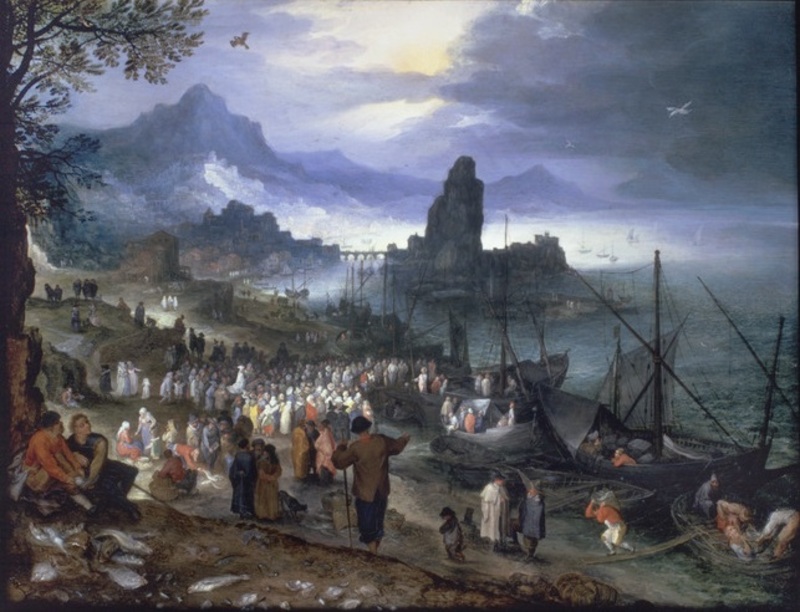
A sermon preached by the Reverend Canon Dr. David Anderson, at St. Jude’s Church, Oakville on January 7, 2026, Feria in Epiphanytide. Title: ‘Turning Toward the Light.’ Text: Matthew 4:12–23.
I speak to you in the + name of Father, Son and Holy Spirit. Amen.
There are moments in scripture when a single line carries far more weight than we first notice. Matthew tells us, almost casually, “When Jesus heard that John had been arrested, he withdrew into Galilee.” It sounds like retreat. It sounds like slipping away quietly to safety. But Matthew is far too careful a storyteller for that.
Jesus does not retreat. He advances. He walks straight into the territory of the man who arrested John — Herod Antipas, a ruler known for his brutality, his paranoia, and his willingness to crush anyone who threatened his power. If John’s arrest foreshadows Jesus’ own, then Jesus’ journey into Galilee is not escape. It is courage. It is purpose. It is the kingdom of heaven stepping directly into the lion’s den.
And where does he go? Not to a fortress. Not to a palace. Not to a centre of influence. He goes to Capernaum — a fishing village of about a thousand people on the northwest shore of the Sea of Galilee. A place of farmers and labourers. A place where people lived close to the edge. A place where Rome’s shadow fell heavily. This is where the Son of God chooses to make his home.
Matthew wants us to see this. The light of God does not dawn first in the halls of power. It dawns among ordinary people — people who work with their hands, who mend nets, who haul fish, who raise families, who wonder how they will make ends meet. People who know what it is to live under someone else’s rule.
Isaiah called this region “Galilee of the Gentiles,” a borderland where identity was mixed, where belonging was fragile, where empire had left deep wounds. And Matthew says: This is where the light begins to shine.
Into this world of danger and darkness and death comes Jesus, proclaiming, “Repent, for the kingdom of heaven has come near.” We often hear ‘repent’ as a word of guilt or shame. But the Greek ‘metanoeo’ means something far more dynamic: turn around. Change direction. Reorient your life. Not is not merely apology, but transformation. Repentance is not about feeling bad. It is about turning towards the light.
And then Matthew gives us two scenes — two moments that show what happens when the light breaks in. Jesus is walking by the lake. He sees two brothers, Simon Peter and Andrew, casting their nets. They are doing what they have done every day of their lives. And Jesus says, “Follow me, and I will make you fish for people.” It is a call to a new vocation. A new purpose. A new way of using the gifts they already have. And without hesitation, they drop their nets — the tools of their trade, the symbols of their security — and follow him.
A few steps later, Jesus sees James and John in a boat with their father. He calls them too. And they leave not only their nets but their father — the centre of their identity, their obligations, their future. In a culture where family was everything, this is astonishing. Jesus is forming a new community, a new family, a new way of belonging. The kingdom of heaven rearranges everything.
But Matthew is honest. As Matthew tells the story in the rest of his Gospel, these disciples who respond so quickly will stumble often. They will misunderstand Jesus. They will fall asleep in Gethsemane. They will run when he is arrested. Peter will deny even knowing him. And yet — and this is the heart of the gospel — Jesus does not give up on them.
After the resurrection, the angel tells the women, “He is going ahead of you to Galilee; there you will see him.” Back to Galilee. Back to the beginning. Back to the place where they first said yes. Back to the place where the light first dawned.
Repentance is not a one-time act. It is a lifelong turning toward Jesus. A lifelong returning to the One who calls us again and again.
And then Matthew ends this section with a simple, powerful summary: Jesus teaches, Jesus proclaims, Jesus heals. He does not merely announce God’s reign — he enacts it. Every word, every touch, every act of compassion is a sign that the powers of darkness are losing their grip. The light is dawning. The kingdom is near. The world is being remade.
So, what does this mean for us? It means that Jesus still walks into places of danger and despair. He still chooses the overlooked places. He still calls ordinary people — people like us — to turn toward the light. It means that discipleship is not about perfection. It is about direction. It is about turning again and again toward the One who goes ahead of us. It means that the kingdom of heaven is not an idea or a doctrine. It is a life. A way of being. A community shaped by grace, courage, and compassion. And it means that even when we fail — when we misunderstand, when we run, when we deny — Jesus calls us back to Galilee. Back to the beginning. Back to the place where he first spoke our name.
The light is still dawning. The kingdom is still near. And Jesus still says, “Follow me.”
May we turn toward that light. May we walk in that way. And may we become, by God’s grace, people through whom that light shines into the world. Amen. +