
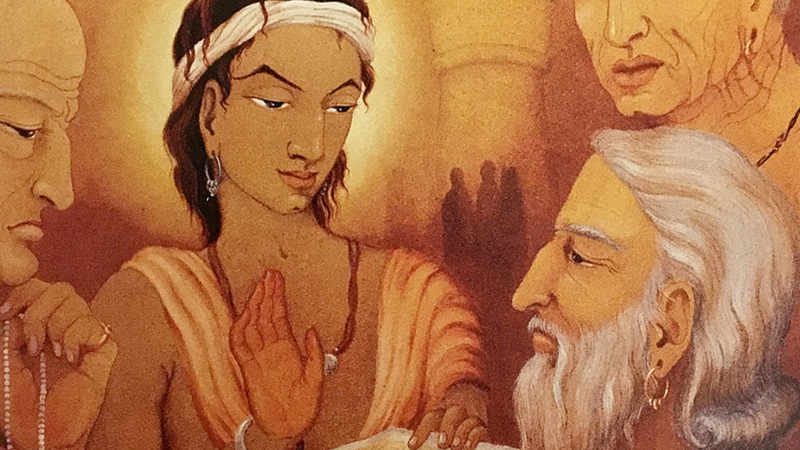
A sermon preached by the Reverend Canon Dr. David Anderson, at St. Jude’s Church, Oakville on Sunday, December 28, 2025, The First Sunday after Christmas.
Title: ‘God’s Protection in Uncertain Times.’ Text: Matthew 2:13–23.
I speak to you in the name of Child born to us, who is + Christ, the Lord. Amen.
We are living in uncertain times. In the wake of the tariff war, market uncertainty, layoffs, and rising costs, many people lie awake at night staring at the ceiling, asking, “What’s going to happen to us? Will we make it? Will we be okay?” Therapists and counsellors tell us anxiety, depression, sleep problems, and family dysfunction are all the result of just these kinds of pressures. Too many people are angry, frightened, and exhausted.
Into a world like this, God speaks a word through a story that is as old as the gospel and as current as today’s headlines: the story of a small family running for their lives, clutching a baby, fleeing the rage of a violent ruler. And incidentally, this action takes place in two locations, Jerusalem and the Palestinian Territory, with similar stories being written today. Today’s Gospel Reading is not a sweet Christmas card picture. It is the story of nightmares, bloodshed, refugees, and yet—through it all—God’s protection.
Matthew tells us that after the magi left, an angel appeared to Joseph in a dream and said, “Get up, take the child and his mother and flee to Egypt… for Herod is about to search for the child, to destroy him.” On the surface, that sounds like a “good” dream: an angel, a divine message, clear instructions, a warning that arrives in time. But think about it. This is a nightmare.
Herod, a paranoid tyrant, with soldiers at his command and no one to hold him accountable, is looking for your baby. The child who has just received gold, frankincense, and myrrh from exotic visitors is now the target of state-sponsored violence. One minute, Joseph and Mary are basking in the glow of worship and wonder; the next, they are stuffing clothes into a bag in the middle of the night, trying to silence a crying child, while listening for the footsteps of soldiers.
The nightmare doesn’t end when Joseph wakes up. It gets worse. There is the frantic journey into Egypt: strange language, different customs, the ambiguity and vulnerability of being refugees—perhaps even undocumented in a foreign land. Behind them, in Bethlehem, Herod unleashes his fury and orders that every boy two years old and under be killed. The cries of mothers fill the streets. Matthew reaches for the words of the prophet Jeremiah: “A voice was heard in Ramah, wailing and loud lamentation, Rachel weeping for her children; she refused to be consoled, because they are no more.” Don’t we see that same sort of lamentation all too often on our news programs each night?
This is one of the darkest scenes in all of scripture. Innocent children are slaughtered because a powerful man is afraid of losing his throne. Yet even here, Matthew insists, God is at work. Even here, God’s purposes are not stopped. Even here, God is protecting the Messiah and, through him, preparing comfort for a weeping world.
Notice how often in this passage we heard the words “in a dream.” Joseph has three dreams after the magi depart. And every one of those dreams swings like a pendulum between hope and fear. The first dream is a nightmare: “Herod is about to search for the child, to destroy him. Flee.” The second dream seems hopeful: “Get up, take the child and his mother, and go to the land of Israel, for those who were seeking the child’s life are dead.” The tyrant is gone. You can go home. But then comes the third dream: Joseph hears that Archelaus, Herod’s son—cruel like his father—is ruling in Judea. He is afraid, and in yet another dream God redirects him to Galilee, to Nazareth, a despised place.
By the time we finish this passage, we realize something crucial: Jesus begins his life as a refugee. From Bethlehem to Egypt, from Egypt back toward Judea, then on to Galilee—his earliest years are marked by danger, dislocation, and dependence on God’s protection. From the very beginning, the One we call Lord and Saviour has “nowhere to lay his head.”
What does this say to us in our uncertain times? First, it reminds us that God’s protection is real, but it does not mean we are spared all pain. God protects the Messiah. Herod does not win. Jesus lives. The cross and resurrection are still ahead. The saving purpose of God is not stopped by tyrants, markets, or monsters. Yet, even as God protects, there is grief. Mothers in Bethlehem still weep. Not every child is carried safely to Egypt. The Bible does not hide this. It tells us the truth about our world: beauty and brutality live side by side.
So, when we talk about “God’s protection in uncertain times,” we do not mean a shallow promise that nothing bad will ever happen. We mean something deeper: that God’s purposes for our lives cannot be defeated; that no power on earth can separate us from God’s love; that in the worst night, when we are running with our fears on our backs, God is still guiding, warning, leading, and providing.
Second, this story shows us how God’s protection often works: quietly, through obedience in the dark. Joseph never gets the whole plan in advance. He doesn’t receive a ten-year strategy. He is simply told, one step at a time, “Get up… take the child… flee… stay… go… turn aside… settle.” Each command comes with just enough light for the next step. Joseph could have argued: “Lord, I don’t understand. Egypt? Really? Why not strike Herod down now? Why this detour?” Instead, Matthew keeps repeating a simple phrase describing Joseph’s actions: “He got up, took the child and his mother…”.
In uncertain times, we want control. We want to see all the way to the horizon. But the God who protected Jesus calls us not to control everything, but to trust enough to obey in the dark. Protection often looks less like a forcefield around our lives and more like a quiet voice saying, “Turn here,” “Wait,” “Not yet,” “Move now.” It looks like daily faithfulness: praying when we don’t feel like it, telling the truth when lying might be easier, forgiving when we’d rather hold a grudge, giving generously when the economy suggests we should cling tightly to every dollar. In those small acts of obedience, God is sheltering our souls and positioning our lives under his care.
Third, this story teaches that God’s protection is not just for us; it is also through us. Jesus spends his earliest years as a refugee child. The Holy Family survives because God warns Joseph—but also because someone in Egypt opened a door, rented a room, did business with a foreign carpenter, allowed a poor family to blend into their neighborhood. God’s protection is not magic done in the sky; it is mercy embodied on the ground.
If that is true, then every time we offer refuge, hospitality, or help to a vulnerable person, we are participating in God’s protective care. When we welcome the immigrant, advocate for the refugee, stand with the family on the edge of eviction, provide a meal for someone going hungry, tutor a child whose parents are overwhelmed, or simply listen to someone whose anxiety is eating them alive, we are, in a real sense, welcoming and protecting Christ himself. “As you did it to one of the least of these,” Jesus will say near the end of Matthew’s Gospel, “you did it to me.”
Matthew will not let us pack away the Holy Family with the decorations. He pushes the manger out into the cold world, where there is still violence, repression, and terror. He asks us: where is the Christ-child fleeing today? Who are the Josephs and Marys running in the night? Where are the children whose futures are being sacrificed to someone’s greed, fear, or ambition? And then he asks a second question: will you be part of God’s protection for them?
Finally, this story calls us to imagine—and to help create—a different future. Joseph’s dreams swing between hope and nightmare. Perhaps we, too, know what it is to swing between a little hope when the bills get paid and deep fear when a new crisis erupts; between trusting God on Sunday and lying awake in the dark on Tuesday. What dream do we wish Joseph could have had? What dream do we wish anxious families today could have?
Imagine Joseph dreaming not of soldiers at the door, but of neighbours stepping forward, of rulers laying down their fear, of safe streets, of open doors. Imagine a world where the Holy Family does not have to run, where refugee camps are empty because peace has come, where no parent has to choose between safety and survival.
I know that such a dream may seem naïve. But it is not. It is the direction of God’s kingdom. The prophets foresaw a day when swords would be beaten into ploughshares, when children would play in safety, when “they shall not hurt or destroy on all my holy mountain.” The escape of the Messiah is the down payment on that day. Herod dies. Archelaus passes. Empires fall. But the child lives. The cross comes, and beyond the cross, resurrection. God’s future is not cancelled by present threats or fear.
So, what do we do in the meantime, in these uncertain times? We bring our anxiety honestly to God, like Rachel who “refused to be comforted.” God can handle our tears and complaints. God welcomes our lament. We practice obedience in the dark, like Joseph, taking the next faithful step even when we cannot see the whole road. We open our eyes to the refugee Christ in our midst—in the struggling neighbour, the frightened child, the unemployed parent, the family in crisis—and we ask, “Lord, how can I be part of your protection for them?” And we let God stretch our imaginations with the dream of a world made new.
You may be lying awake at night, heart racing, wondering how you will make it through the next month, the next year. Hear the quiet message of Matthew, chapter 2: God’s protection is present even in the nightmare. The same God who watched over that small family in the dark watches over you. The same God who led them step by step will lead you. The same God who preserved the life of the Messiah will preserve his purposes in your life.
Herod’s rage is real, but it is not final. Economic upheaval is real, but it is not ultimate. Political turmoil is real, but it is not the last word. The last word belongs to the One who fled as a child and returned as a Saviour, who knew danger and displacement and yet brought saving grace into the world.
Rest, then, not in the illusion of certainty, but in the reality of God’s care. You may not know what tomorrow holds, but you know who holds you. Underneath are the everlasting arms. In Christ, you are seen, you are led, and you are protected—even in uncertain times.


