
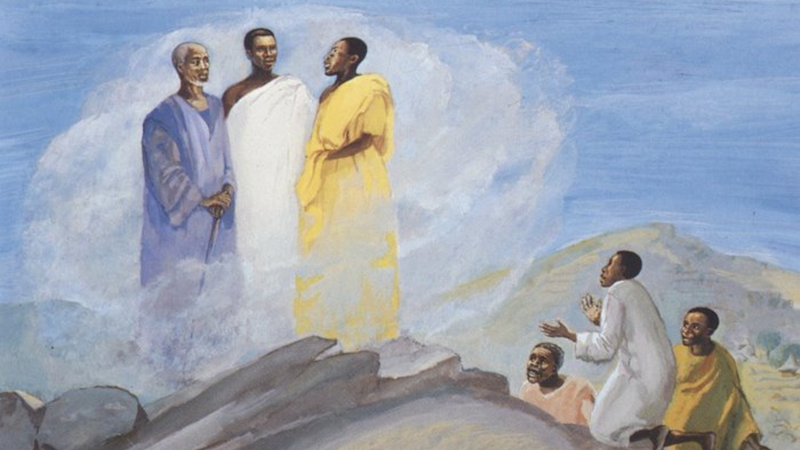
A sermon preached by the Reverend Canon Dr. David Anderson, at St. Jude’s Church, Oakville on Sunday, February 15, 2026, Transfiguration Sunday: The Last after Epiphany. Title: ‘Listen to Him.’ Text: Matthew 17:1–9.
I speak to you in the + name of Father, Son and Holy Spirit. Amen.
We have spent these weeks of Epiphany which conclude today standing in the light. Epiphany is the season when the church holds up the Christ-child—still fresh from the manger—and asks, “Who is he, really?” It is the season of illumination, of revelation, of discovery. If Christmas is the gift, Epiphany is the slow, careful unwrapping of it. Layer by layer, Sunday by Sunday, we discover what it means that the one greeted by shepherds and magi is also the Light of the World. And we discover, sometimes with surprise, that we are called to shine with that same light. Today, on this final Sunday of Epiphany, we reach the last fold of wrapping paper. And what we find is dazzling.
“Transfiguration” is not a word we use at the grocery store or in conversation with friends. It’s a strange word for a strange moment. And it’s easy to forget that for many of us, this Sunday feels like a puzzle piece that doesn’t quite fit.
But the church, in her wisdom, places this story here—at the hinge between Epiphany and Lent—because it gathers up everything we’ve been learning about Jesus and what it means to follow him and points us toward everything we are about to face in our journey with Jesus towards the cross and resurrection.
At Jesus’ baptism, at the very beginning of Epiphany, a voice from heaven declared, “This is my Son, the Beloved, with whom I am well pleased.” Today, on the mountaintop, we hear the same voice and the same message again—but with an addition: “Listen to him.” The season that began with revelation now ends with invitation.
Matthew tells us that this moment happens six days after Jesus first tells his disciples that he will suffer and die. Six days after Peter rebukes him. Six days after Jesus says, “If any want to become my followers, let them take up their cross and follow me.”
And then—this. A mountain. A shining face. Clothes bright as the sun. Moses and Elijah appearing in glory. A cloud of divine presence. A voice from heaven. It is as if God is saying, “Before you walk into the valley of Lent, before you watch my Son walk toward the cross, you need to see who he really is.”
Peter, bless him, does what many of us would do when confronted with something overwhelming: he tries to do something. “Let me build three tents,” he says. Let me preserve this moment. Let me make it manageable. Let me hold onto the glory. But Matthew tells us that the voice from heaven interrupts him. Cuts him off mid-sentence. Because there is only one thing that matters: “This is my Son, the Beloved… listen to him.” Not “build something.” Not “capture this.” Not “stay here forever.” Just listen. It is a word for Peter, James, and John who were present with Jesus on that mountain. It is a word for the church. It is a word for us.
And then—just as suddenly as it began—the moment ends. The cloud lifts. Moses and Elijah vanish. The light fades from Jesus’ face. The disciples fall to the ground in fear. And what remains? Not the glory. Not the spectacle. Not the mountain-top high. Just Jesus. Jesus, reaching out. Jesus, touching them. Jesus, saying, “Get up”—or more literally, “Be raised.” It is the same verb Matthew will use for Easter morning. Even here, on the mountain, resurrection is already humming beneath the surface. Transfiguration Sunday is a strange day because it looks in three directions at once:
- Back to Jesus’ baptism, where the voice first declared him beloved.
- Forward to the cross, where the disciples will struggle to listen.
- Beyond to the resurrection, which alone makes sense of this moment.
It is a day that gathers up the light of Epiphany and pours it into the path that leads to Lent. It is a day that reminds us that glory and suffering are not opposites in the Christian life—they are intertwined. It is a day that tells us that when all the brightness fades, when the cloud lifts, when the mountaintop moment ends, Jesus remains.
But here is where the story presses into our own lives. Most of us do not live on mountaintops. Most of us live in the ordinary. In the school drop-off zone. In the grocery store aisle. In the waiting room. In the kitchen after dinner. In the quiet moments of worry that come just before sleep. In the long, slow work of caring for others. In the routines that feel repetitive, unremarkable, unseen. And the question Transfiguration Sunday asks is this: What does it mean to follow the radiant Christ when life feels anything but radiant?
The voice from heaven says, “Listen to him.” Not “admire him.” Not “understand everything he says.” Not “feel inspired all the time.” Just listen. Listening is an ordinary act. It happens in the midst of dishes and deadlines and doctor’s appointments. It happens when we pause long enough to let Jesus’ words shape our reactions, our choices, our priorities. Listening to Jesus in the ordinary might look like:
- Choosing gentleness when irritation feels easier.
- Offering forgiveness when resentment feels justified.
- Speaking truth when silence feels safer.
- Making space for someone else’s story when our own feels loud.
- Praying a simple prayer—“Lord, have mercy”—in the middle of a busy day.
Listening is not glamorous. It is not a mountaintop moment. But it is the heart of our Christian discipleship.
On the mountain, Jesus shines like the sun. In the valley, he looks like a man walking dusty roads. Most of our days look like the valley. But the Transfiguration teaches us that the Jesus who shines is the same Jesus who walks beside us in the ordinary. The same Jesus who cooks breakfast for his friends. The same Jesus who touches the sick. The same Jesus who notices the people others overlook. The same Jesus who prays quietly in the dark. Following Jesus in the ordinary means trusting that he is present even when we do not feel the glow of the mountaintop. It means believing that holiness is not confined to spectacular moments but is woven into the fabric of our daily life.
When the disciples fall to the ground in fear, Jesus touches them and says, “Be raised.” He does not say, “Try harder.” He does not say, “Pull yourself together.” He does not say, “Come back to me when you understand.” He raises them. And he does the same for us. In the ordinary places where we feel overwhelmed, discouraged, or weary, Jesus reaches out—not with judgment, but with resurrection. Being raised in the ordinary might look like:
- Finding strength you didn’t know you had.
- Receiving kindness you didn’t expect.
- Feeling hope flicker again after a long season of heaviness.
- Discovering that God has been carrying you when you thought you were walking alone.
Resurrection is not only for Easter morning. It is for Tuesday afternoons. It is for the middle of February. It is for the quiet corners of our lives where we need to be lifted up.
The disciples needed the mountaintop moment—not so they could stay there, but so they could walk faithfully with Jesus into the valley. We need it too. We need moments of clarity, beauty, and spiritual intensity—not as escapes from ordinary life, but as reminders of who Jesus is when life becomes difficult. The Transfiguration is not an invitation to stay on the mountain. It is a promise that the One who shines in glory is the same One who walks with us into the valley.
And so friends, as we step from Epiphany into Lent this week, the church invites us to listen—to listen to the One who is both radiant in glory and steadfast in suffering. To listen when his words comfort us. To listen when his words challenge us. To listen when his path leads upward. To listen when his path leads downward. Because the One who shines on the mountain is the same One who kneels to wash feet, who carries a cross, who breaks bread, who rises from the dead, and who walks beside us still.
The light of Epiphany has shown us who Jesus is. The journey of Lent will show us what that love costs. And Easter will show us what that love conquers. For now, we stand with Peter, James, and John—dazzled, confused, overwhelmed—and we hear the voice that still speaks: “This is my Son, the Beloved… listen to him.” Amen. +


