
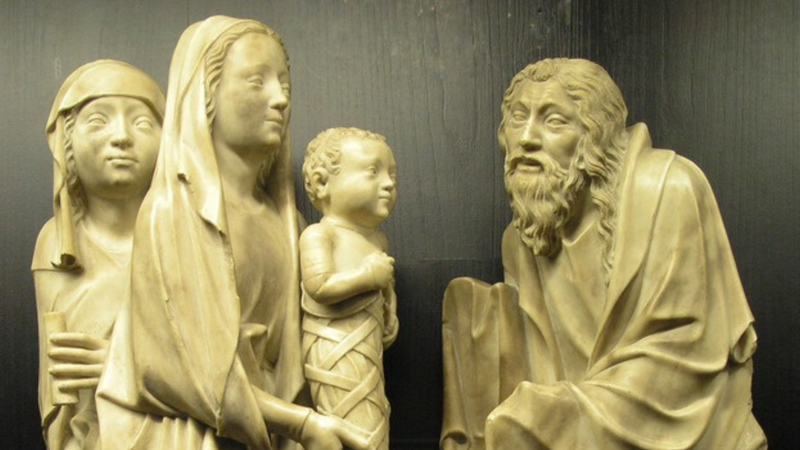
A sermon preached by the Reverend Canon Dr. David Anderson, at St. Jude’s Church, Oakville on Sunday, February 1, 2026, The Fourth Sunday after Epiphany.
Title: ‘Blessed Are the People of God.’ Text: Matthew 5:1–12.
I speak to you in the + name of Father, Son and Holy Spirit. Amen.
There are moments in Scripture when the scene slows down, when the camera lens tightens, when we are invited to pay attention because something foundational is about to happen. Matthew 5 is one of those moments. Jesus has been baptized. He has been tempted. He has called his first disciples. He has healed the sick and proclaimed the good news. And now, Matthew tells us, Jesus “went up the mountain.”
For Matthew’s audience, that phrase alone—he went up the mountain—would have rung like a bell. Mountains are where God speaks. Mountains are where God forms a people. Moses went up the mountain and received the law. Elijah went up the mountain and heard the still, small voice. Mountains are places of revelation, transformation, and commissioning.
So, when Jesus goes up the mountain and sits down—taking the posture of a rabbi, a teacher with authority—we are meant to understand that something is about to happen. We are about to encounter a new Moses. We are about to learn about a new covenant. We are about to be invited into a new way of being God’s people.
And who is gathered around him? Not the crowds, though they are present. Not the religious elite. Not the powerful. Not the wealthy. But four fishermen—Andrew, Peter, James, and John. Four ordinary men who have left their nets but have not yet learned what discipleship will cost them. Four people who have said ‘yes’ to Jesus but do not yet know what that yes will require. It is to these first disciples that Jesus speaks, and it is to all of us who in the future would seek to follow him.
To them—and to us—Jesus offers the overture to his greatest sermon. Not a list of commands. Not a set of rules. Not a moral checklist. But a vision. A blessing. A declaration of who God’s kingdom belongs to and what kind of world God is bringing into being.
The Beatitudes are not abstract spiritual ideals. They are not embroidered sentiments for wall hangings. They are the preamble to Jesus’ ministry, the constitution of the kingdom, the DNA of discipleship. And they are deeply embodied—rooted in the real suffering, real longing, and real hope of real people.
Let us listen again, with fresh ears, to the blessings Jesus pronounces.
Blessed are the poor in spirit, for theirs is the kingdom of heaven. We often spiritualize this one. We imagine “poor in spirit” means humble or modest. But in the world Jesus inhabited, poverty was not a metaphor. It was a crushing, daily reality. The poor in spirit were those whose material deprivation had worn down their hope. Those who laboured endlessly and still could not provide for their families. Those whom society had forgotten.
Jesus does not say, “Blessed are the poor in spirit because poverty is good.” He says, “Blessed are the poor in spirit because God’s kingdom belongs to them.” In God’s kingdom, no one is crushed by scarcity. No one is left behind. No one is disposable. This is not a spiritual platitude. It is a promise of reversal.
Blessed are those who mourn, for they will be comforted. Grief was a constant companion in the ancient world. Infant mortality was high. Disease was rampant. Violence was common. And for Jesus’ audience, grief also included the loss of land, autonomy, and dignity under Roman occupation. Matthew’s community, hearing these words after the destruction of the Temple in 70 CE, would have felt this deeply. Their sacred centre was gone. Their homeland violated. Their identity shaken.
Jesus does not deny their grief. He does not rush them past it. He blesses them in the midst of it. And he promises comfort—not the comfort of distraction or denial, but the comfort of restoration. The comfort of God’s presence. The comfort of a future where mourning will be no more.
Blessed are the meek, for they will inherit the earth. The meek are not—as we might imagine—the timid. Jesus is not thinking of those who are necessarily passive. Jesus refers to those who have been abused by the powerful, those who have been trampled by systems that reward greed and punish vulnerability.
Psalm 37, which Jesus echoes, contrasts the meek with the wicked who prosper. Rome was full of such wickedness—extracting wealth from the poor, seizing land, exploiting labour.
Again, Jesus’ blessing promises a great reversal. Jesus promises that the meek—not the empire, not the wealthy, not the violent—will inherit the earth. God’s future belongs to those who have been wronged, not those who have done the wronging.
Blessed are those who hunger and thirst for righteousness, for they will be filled. The ‘righteousness’ Jesus speaks about here is not personal piety. It is not moral purity. It is the Hebrew concept of a state of affairs that can be described as a just social order, a community where resources are shared equitably, where all have enough.
Those who hunger and thirst for righteousness—this promised state of affairs—are those who know what it is to be denied justice. These are often people who live at the margins because the system is rigged against them. These are those who long for a world where everyone has enough bread, enough dignity, enough hope. Jesus promises that in God’s kingdom, their hunger will be satisfied. Justice will roll down like waters. Righteousness will flow like an ever‑flowing stream.
Blessed are the merciful, for they will receive mercy. This blessing has much to say to a view of the world that we have heard much about in the news recently. We recently heard the Prime Minister of Canada observe that when it comes to dealing with the world’s great powers, “If you’re not at the table, you’re on the menu.” In some way, his observation responded to the words of Stephen Miller, White House Deputy Chief of Staff, a top advisor in the Trump administration, repeated several times this month. In one interview Miller observed, “We live in a world, in the real world, … that is governed by strength, that is governed by force, that is governed by power. These are the iron laws of the world since the beginning of times” (Miller in an interview with Jake Tapper, CNN). Miller was justifying US intervention in Venezuela and the threat to acquire Greenland by force if necessary. Many were appalled by Miller’s bald statement which seemed to support the right of powerful nations to exploit smaller ones. The appalling thing, however, is that Miller is correct. It is the way the world works and it is the way that the world has worked for a long time.
Mercy was not a Roman virtue. Rome valued strength, dominance, and control. Mercy was weakness. Mercy was foolishness. Mercy was for the conquered, not the conquerors. But in God’s kingdom, mercy is the currency. Mercy is the ethic. Mercy is the way.
Those who give of their resources, who care for the outcast, who refuse to participate in cycles of cruelty—these are the ones who reflect God’s heart. And they will receive mercy in return, not as a reward, but as the natural outflow of God’s character.
Blessed are the pure in heart, for they will see God. Purity in heart is not about ritual cleanliness. It is about integrity. Wholeness. Alignment between inner life and outer action. Jesus will later teach that the heart is the wellspring of discipleship. What we love shapes what we do. What we desire shapes how we live.
The pure in heart are those who seek God without hypocrisy, who desire God’s will more than their own comfort, who allow God to shape their inner world. To them, Jesus promises the most intimate blessing imaginable: they will see God. Not in abstraction. Not in theory. But face to face.
Blessed are the peacemakers, for they will be called children of God. Rome claimed to bring peace—the famous Pax Romana. Caesar had is own ‘Board of Peace.’ But Rome’s peace was built on violence, coercion, and fear. It was peace for the powerful and oppression for everyone else. Jesus’ peace is different. It is not the absence of conflict. It is the presence of justice. It is the refusal to use violence to achieve God’s ends. It is the commitment to God’s wholeness and well‑being for all people.
Peacemakers are those who resist the empire’s way and embody God’s way. They are God’s children because they resemble their Father.
Blessed are those who are persecuted for righteousness’ sake. Jesus ends with a warning and a promise. Those who live according to the Beatitudes—those who stand with the poor, comfort the grieving, resist injustice, practice mercy, pursue purity, and make peace—will face resistance. Not because they are doing something wrong, but because they are doing something right. The world is not neutral. Systems of power do not yield easily. When we align ourselves with God’s kingdom, we inevitably challenge the kingdoms of this world.
Jesus does not romanticize persecution. He does not tell us to seek it. But he tells us not to be surprised by it. And he promises that those who endure will share in the joy of heaven.
So what does this mean for us? We live in one of the wealthiest nations in human history. Many of us live comfortable lives. We are not crushed by poverty. We are not living under military occupation. We are not persecuted for our faith. And yet, the Beatitudes still speak to us. They call us not to pity the poor, but to stand with them. Not to avoid grief, but to accompany those who mourn. Not to admire the meek, but to challenge the systems that exploit them. Not to hunger for personal success, but to hunger for justice. Not to practice mercy occasionally, but to make it our way of life. Not to settle for superficial religion, but to cultivate purity of heart. Not to avoid conflict at all costs, but to make peace through justice. Not to fear resistance, but to persevere in love.
The Beatitudes are not a description of who we already are. They are an invitation to become who God calls us to be. They are not a list of virtues for the spiritually elite. They are a roadmap for discipleship. They are not a passive blessing. They are a commissioning. Jesus is forming a people who will embody God’s kingdom in the world. A people who will live differently. A people who will challenge the status quo. A people who will make visible the reign of God.
When we understand the Beatitudes in embodiment rather than abstraction, we begin to see how they call us to action.
- To bless the poor in spirit is to work for economic justice.
- To bless those who mourn is to show up in grief with compassion and solidarity.
- To bless the meek is to confront systems that exploit and abuse.
- To bless those who hunger for righteousness is to join the struggle for equity.
- To bless the merciful is to practice generosity and forgiveness.
- To bless the pure in heart is to cultivate integrity and authenticity.
- To bless the peacemakers is to resist violence in all its forms.
- To bless the persecuted is to stand firm in the face of resistance.
This is not easy work. It is not glamorous work. It is not always safe work. But it is kingdom work. And Jesus promises that those who take up this work are blessed—not because the work is easy, but because God is with them. God is for them. God is shaping them into the likeness of Christ.
When Jesus goes up the mountain, he is not giving a lecture. He is forming a community. He is shaping a people. He is calling disciples into a new way of life. The Beatitudes are not simply words to admire. They are a life to embody. And so, as we hear these blessings today, may we allow them to shape us. May we allow them to challenge us. May we allow them to call us deeper into the heart of God.
- Blessed are the poor in spirit.
- Blessed are those who mourn.
- Blessed are the meek.
- Blessed are those who hunger and thirst for righteousness.
- Blessed are the merciful.
- Blessed are the pure in heart.
- Blessed are the peacemakers.
- Blessed are the persecuted.
Blessed are you … blessed are we—when we follow Jesus into the world he is remaking. Amen. +


