
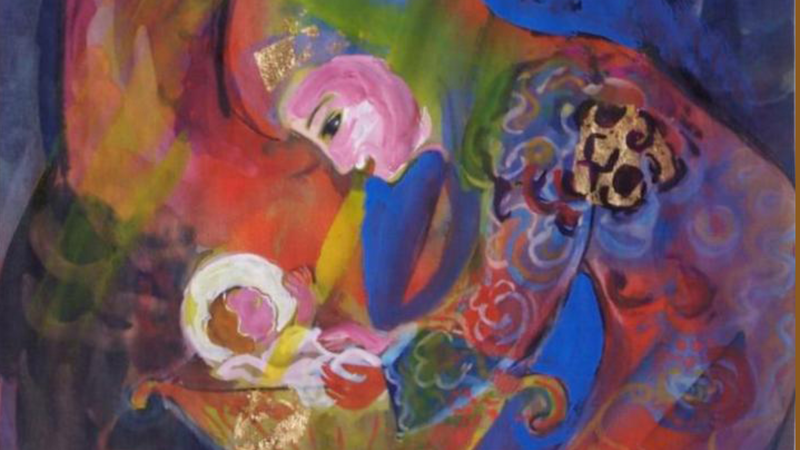
A sermon preached by the Reverend Canon Dr. David Anderson, at St. Jude’s Church, Oakville on Wednesday, December 24, 2025, The Nativity of our Lord. Title: ‘Christmas Comes to Us in the Middle of Real Life.’ Text: Luke 2:1-20.
I speak to you in the One born to us this night, Jesus, who is Christ, the Lord. Amen.
“Christmas still comes to us in the middle of real life.” That is where I want to begin in tonight’s homily. Christmas comes, not in a snow globe, not in a postcard, not in a perfectly staged nativity set with everyone looking serene and unbothered—but in the middle of real life. Real life with inflation and anxiety, with wars we can’t stop watching on our screens, with family tensions at the dinner table, with grief that shows up uninvited in the middle of “Joy to the World.” Christmas does not wait for us to get our lives together. It arrives anyway.
Luke’s story of Jesus’ birth insists on this. It will not let us forget the world into which Christ is born. Luke begins his story of Jesus’ birth by naming the powerful: Caesar Augustus, the Roman Emperor, and Quirinius, the Governor of Syria. He roots the story not in fantasy, but in history—in context of empire, policy, and power. Mary does not travel to Bethlehem because she is feeling pious and nostalgic; she travels because the emperor has spoken and the empire must be obeyed.
A decree goes out: “all the world” is to be registered. It’s the language of total control. Luke knows, of course, that Augustus doesn’t literally rule “all the world,” but that is how empire talks. Empire speaks as if it owns everything. It owns everyone. It claims every life, every human body, every coin, every choice.
And into that world, Mary and Joseph are pushed and pulled. They are made to walk, while pregnant, because powerful people far away need numbers on a scroll so they can decide how much more to take. The journey to Bethlehem is not a quaint prelude to a sweet nativity scene; it is a picture of how empire reaches into the lives of ordinary people and rearranges them for its own purposes.
We know something about that, even now. We live in one of the wealthiest countries on earth, and yet, as we were reminded this week, in the Globe and Mail, and other places, one in four people in this country—including 2.5 million children—lives in a food‑insecure household. That is not simply unfortunate. It is not simply “the way things are.” That is the result of decisions: economic systems, political choices, structures that work very well for some and very poorly for many. Rents rise. Grocery prices climb. Transportation costs increase. People who work full time still cannot afford the basics. Seniors count pills and coins. Students choose between heat and food. Families skip meals so their children can eat.
And then, into the gaps left by that system, step food banks, community meals, and the likes our own Pantry Program. This year, our St. Jude’s Pantry Program produced and delivered 12,000 meals. That is beautiful. That is holy work. It is also a sign of something deeply wrong. Because food banks, and programs like ours, were never meant to replace just policy, fair wages, or a housing system where people can actually live without fear.
In that sense, our world is not so different from Luke’s. Empire still writes the rules. It may not call itself empire, but it behaves like one. It organizes life around profit and power. It claims to bring peace and prosperity—remember “Pax Romana,” the Roman Peace—but that peace was built on conquest, extraction, and control. Today’s versions of empire promise stability and growth while leaving multitudes behind.
Luke knows about empire. That is why, right from the start, he places Jesus’ birth face‑to‑face with Caesar’s world. Caesar decrees a census that pretends to be “for all the world”; God sends an angel with “good news of great joy for all people.” Do you hear the contrast?
“Do not be afraid,” the angel says to the shepherds. “For see—I am bringing you good news of great joy for all the people: to you is born this day in the city of David a Saviour, who is the Messiah, the Lord.” The first thing to notice is who hears this news: not Caesar, not the governors, not the high priests, not the wealthy patrons. Shepherds. Field workers. People without status, without security, living outdoors because they have to, not because they are on a rustic holiday.
They have also heard the emperor’s claims about peace and salvation. They have also felt the census and the taxes. They know what it is to be counted by empire, not because they matter, but because their labour and their money matter.
And into their ordinary, hard, vulnerable lives, the angel speaks: “To you is born this day….” Not simply “A child is born,” but “to you is born.” To you who live outdoors. To you who work nights. To you who are just trying to make it through another shift, another season, another round of uncertainty. To you is born this day a Saviour. And not in Rome, but “in the city of David.” Luke shifts the frame. Until now he has set the story against the backdrop of imperial power. Now he reminds us of a different story unfolding in the world—God's story, the story Israel, the story of David, the shepherd‑king, the story of a God who hears the cries of slaves in Egypt, who brings down the mighty from their thrones and lifts up the lowly.
“To you is born this day in the city of David a Saviour, who is the Messiah, the Lord.” Those three words—Saviour, Messiah, Lord—are loaded. Augustus was claimed the title “saviour.” Caesar was hailed as “lord.” Power in Luke’s world is tied up with those titles. Luke dares to say that the true Saviour, the true Lord, the true Anointed One is not seated on a throne in Rome but lying in a feed trough in Bethlehem. Can you imagine?
And this is the sign: not a golden crown, not a polished palace, not an army at his command. “This will be a sign for you: you will find a child wrapped in bands of cloth and lying in a manger.” A child, poorly housed. Born to a family on the move because an empire needed to get its numbers right. This is how God comes. Not above the machinery of power, but underneath it. Not insulated from the consequences of bad policy, violence, or greed, but vulnerable to them. God does not save us by avoiding our reality. God steps directly into it.
So, when we ask, “What good news can possibly speak into this world where we live?”—into our food insecurity, our housing crisis, our wars, our divisions, our social‑media‑fueled hatred—Luke’s answer is not an escape plan, not a spiritual distraction. Luke’s answer is a birth. A baby whose first cry is heard not in a palace, but in a place where working people can find him.
And the angels sing: “Glory to God in the highest heaven, and on earth peace among those whom he favours.” “Peace on earth” is not a slogan on a Christmas card. It is a direct challenge to every system that uses people up and calls it peace. The peace Jesus brings is not the calm of resignation, but the peace of a reordered world: where the hungry are filled with good things, and the lowly are lifted up, and the proud and powerful are sent away empty.
So, what does that mean for us on this night, in this place, in this moment of history? First, it means we are invited to hear the angel’s words as addressed to us: “Do not be afraid.” Not because there is nothing to fear, but because fear does not have the final word over us. The same God who entered a world of occupation, poverty, and political violence has entered ours. The same God who chose to be born in vulnerability is present in the vulnerabilities we carry tonight.
For some of us, that fear is financial: bills we can’t pay, work that is precarious, futures that feel uncertain. For others, it is loneliness, illness, broken relationships, climate anxiety, grief that sits so close to the surface it takes our breath away. Whatever your fear, the gospel does not tell you to pretend it isn’t real. It says: God has come into it. To you. For you.
Second, this story calls us not just to feel comforted, but to be converted—to have our imaginations changed about what power is, what salvation looks like, and what our lives are for.
If the true Saviour comes as a child laid in a manger, then real power is not domination but vulnerability in love. If the first to hear the good news are working people in the fields, then God’s heart is turned first toward those our systems count last. If the place where Christ is born is shaped by empire’s census and taxation, then God’s salvation must have something to say about economic injustice, hunger, and housing—not just about our inner, private lives.
We cannot celebrate the birth of this child and be indifferent to the world that child entered. So, when we run a Pantry Program that serves 12,000 meals, we are not just “being nice.” When we serve meal in our local homeless shelter, we are not just doing something “politically correct.” We are bearing witness to a different kingdom, a different kind of rule. We are saying, in our small but concrete way, that in the world God is bringing about, no one is disposable and no one goes hungry. Whenever we care for our vulnerable neighbours, we are not “getting political” in a way that competes with the gospel, we are living out the gospel’s political claim: that Jesus is Lord, and therefore Caesar—whatever form Caesar takes in our time—is not.
Third, this story invites us to locate ourselves with the shepherds. Notice what they do after the angels leave. They say to one another, “Let us go now to Bethlehem and see this thing that has taken place.” They move. They act. They seek. And when they find Mary and Joseph and the child lying in the manger, they tell what they have heard. They become the first preachers of the good news. Then they return to their fields—still under empire, still working hard—but “glorifying and praising God for all they had heard and seen.” The world has not yet changed in its outward structures. But they have been changed. Their understanding of what is ultimate, of who is Lord, of where hope lies—that has shifted.
Tonight, we too will go back to our fields—to our homes, our jobs, our classrooms, our neighbourhoods, our online spaces. The question is: will we go back as people who have only heard a familiar story once again? Or will we go back as people who have encountered, again, the disruptive, life‑giving counternarrative Luke offers? Can we look at our world, with all its fear and uncertainty, and quietly—but stubbornly—say: “This is not the only story. There is another story at work. A child has been born. A different kind of kingdom has begun”?
To live as if that is true is to start embodying the good news in small, steady ways. It may look like refusing to let cynicism have the last word when we talk about politics and economics—because we worship a God who can bring life out of occupied territory and a manger. It may look like choosing generosity in a season of anxiety: sharing what we have, making room at our tables, supporting the work that resists hunger and homelessness. It may look like listening with patience across deep divisions, insisting that the person in front of us is never our enemy, because the child born in Bethlehem is good news “for all people.” And it certainly looks like worship: gathering, as we are tonight, to sing with the angels, to kneel with the shepherds, to ponder with Mary, to let this story re‑shape our hearts and habits.
The empire—ancient or modern—says: “This is how the world is. Power belongs to the strong. The poor are inevitable. Fear is realistic. Nothing truly new is possible.”
The gospel of this night says: “No! Something new has already begun. Power has been revealed in weakness. God has chosen the poor. Fear does not get the final word. A new creation is underway in the cry of this child.”
And so Christmas comes to us in the middle of real life—exactly where we need it to be. Not after the war ends, but in the midst of it. Not after the policies are fixed, but while we are still struggling for justice. Not after your grief is resolved, but right in the ache of it. Not after your questions disappear, but while you are still wondering if any of this can really be true. Into that world, your world, God has come.
“To you is born this day…” To you who are tired. To you who are hopeful. To you who are numb. To you who are joyful beyond words. To you who are hanging on by a thread. To you is born this day a Saviour.
So come, in your real life, with your real fears and your real hopes. Come and kneel at the manger of the One who has stepped into our history, our systems, our sorrows, and our joys—not to bless the way things are, …but to begin, in himself, the way things shall be. A world where the hungry are fed, not by emergency charity alone, but by shared abundance and just structures. A world where housing is not a privilege but a given. A world where peace is not secured by threat, but by reconciliation. A world where every child is received as a sign of God’s image and God’s future. That world has its quiet, stubborn beginning in Bethlehem.
Tonight, as we gaze again at this child, may our imaginations be converted. May our fears be met with the angel’s “Do not be afraid.” May our weariness be met with the good news of great joy for all people. And may our ordinary lives become, by the grace of God, places where this counter‑story of Jesus is lived out—where empire’s logic is quietly challenged by acts of generosity, courage, and love.
For to us—to you—is born this day in the city of David a Saviour, who is Christ, the Lord.
Thanks be to God. Amen.


