
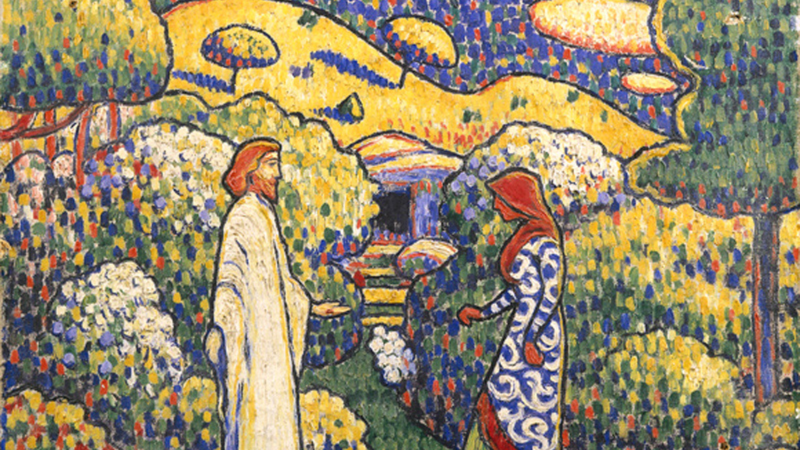
A sermon preached by the Reverend Canon Dr. David Anderson, at St. Jude’s Church, Oakville on Sunday, April 5, 2026, Easter Sunday.
Title: ‘I Have Seen the Lord.’ Text: John 20:1–18.
I speak to you in the + name of our risen Lord. Amen.
Early on the first day of the week, while it is still dark, Mary Magdalene comes to the tomb.
John could have said “at dawn,” or “as the sun was rising,” or “when the morning light broke across the sky.” But he doesn’t. He wants us to feel the darkness — not just the physical darkness of early morning, but the emotional and spiritual darkness that Mary carries with her.
She comes to the tomb because love does not know what else to do. She comes because grief has its own gravity. She comes because when you have lost someone who changed your life, you go to the last place you saw them, even if you don’t know what you’ll find.
And that is where Easter begins. Not with certainty. Not with trumpets. Not with lilies or alleluias. But with a woman walking through the dark, carrying her grief, unsure of what comes next.
If you are here this morning carrying your own darkness — uncertainty, loss, exhaustion, questions you don’t know how to ask — you are in the right place. Easter begins in the dark.
Mary sees the stone rolled away, and she runs. But she does not run to proclaim resurrection. She runs to report a tragedy. “They have taken the Lord out of the tomb, and we do not know where they have laid him” (v. 2b). The empty tomb, by itself, is not a sign of hope. It is an absence. A wound reopened. A mystery that feels more like a threat than a promise.
Peter and the beloved disciple run to see for themselves. They look in. They see the linen wrappings. One “believes,” John says — but even then, “they did not understand the scripture.” They return home. Mary stays.
This is one of the most honest moments in Scripture. Three disciples encounter the same scene, and each responds differently. One runs. One looks and leaves. One stays and weeps. Faith is not a single pathway. It is a landscape with many paths. And God meets people on all of them.
If you are running today — full of energy, full of questions — God meets you. If you are stepping back, unsure what to make of any of this — God meets you. If you are staying in the place of sorrow because you cannot yet move — God meets you. Easter is not a race. Easter is not a test of spiritual vigour. It is God’s new creation breaking into whatever place we find ourselves.
Mary bends to look into the tomb again, and this time she sees two angels. But notice what they do not do. They do not announce resurrection. They do not explain the mystery. They do not offer a theological lecture. They ask a question: “Woman, why are you weeping?” (v. 13b). It is not a rebuke. It is an invitation — to name the truth of her heart. Easter does not erase grief. It meets us in it. The angels do not hurry Mary past her sorrow. They honour it. They make space for it. They let her speak. And then something shifts.
Mary turns and sees Jesus standing there, but she does not recognize him. Resurrection is not simply life resumed. It is life transformed. It is new creation. John clearly wants us to hear echoes of Genesis, the ancient story of God good creation. A garden. A new dawn. A new Adam.
Jesus speaks to her, but she still does not know him. She thinks he is the gardener — which, in a way, he is. The One through whom all things were made is now tending the first morning of the new creation.
And then he speaks her name. “Mary” (v. 16a). It is the moment everything changes. Resurrection is cosmic — the defeat of death, the renewal of creation — but it is also deeply personal. It begins with being known. Called. Claimed. Before Mary can proclaim the gospel, she receives it in the most intimate way: her name spoken by the One she thought she had lost.
For every person here today — whether you come every Sunday or haven’t been in a church for years — Easter begins with this: God knows your name. God calls you into life. God meets you where you are.
Mary does what any of us would do. She reaches out. She clings to him. She tries to hold on to the moment, to the miracle, to the One she loves. And Jesus says, “Do not hold on to me” (v. 17a). This is not rejection. It is invitation. Jesus is not saying, “Don’t touch me.” He is saying, “Don’t cling to the way things were.” Resurrection does not return us to the past. It opens a future we could not have imagined.
Jesus is going ahead — to the Father, to the disciples, to the world. And Mary is invited to go too. Not to stay in the garden, but to step into the mission of God. To join God in the work that Jesus has done, restoring and redeeming all things, making all things new, returning the creation to the state of flourishing, healing all that is broken, setting right everything in our world that gone off the tracks.
Jesus sends Mary with a message: “Go to my brothers and say to them…” (v. 17b). And Mary becomes the apostle to the apostles — she brings the first message to the messengers; she is the first witness, the first preacher, the first to carry resurrection into the world.
Her sermon is beautifully simple: “I have seen the Lord.” Her sermon is different than many sermons you may have heard. She does not say, “I have understood everything.” She does not say: “I have solved the mystery.” She does not say, “I have no more questions.” She simply says, “I have seen him.”
This is the heart of Christian faith. Not certainty, not perfect understanding, not theological mastery — but encounter. Relationship. Recognition. Easter is not something we explain. It is something we witness.
So what does this story mean for us — gathered here in this place, with our mix of faith and doubt, joy and sorrow, familiarity and newness? First, this story is a reminder that Easter arrives in the dark. If your life feels like early morning before the sun has risen — if you are carrying grief, or fear, or exhaustion — Easter is for you. God does not wait for you to be ready. God comes to you in the dark.
Second, we are reminded this morning that God transforms what we cannot. The empty tomb is not something Mary or Peter or the beloved disciple could have engineered. Resurrection is God’s work. God’s initiative. God’s gift. Where you see only endings, God is already at work creating beginnings.
Third, Easter tells us that our name is known. Before Mary understands resurrection, she is known by name. Before she believes, she is loved. Before she proclaims, she is called. You are not a stranger to God. You are not forgotten. You are not lost in the crowd.
Finally, Easter tells us that we are sent. Mary does not stay in the garden. She goes. She carries resurrection into the world. And so do we. Easter is not the end of the story. It is the beginning of a new one — a story in which we are invited to participate. A story in which love is stronger than death, forgiveness stronger than fear, hope stronger than despair. This is the story that God is writing in the world and it is a story that refutes many of the stories with currency in our world today. Some of those stories tell us that ‘might makes right,’ or that ‘humility is for losers,’ or that ‘forgiveness is for the weak.’ But this story tells us that the way to find your life is to lose it, that sacrificial self-giving love is the most powerful force at work in the world, and that all the forces that seek to harm and destroy us are already and ultimately defeated.
So on this Easter morning, hear the good news: In the dark — Christ is risen. In the confusion — Christ is risen. In the grief you carry — Christ is risen. In the questions you cannot yet answer — Christ is risen. And Christ is calling your name.
Whether you are here every week or visiting for the first time, whether you feel full of faith or unsure what you believe, whether you come with joy or with heaviness — Easter is for you.
Not because you have everything figured out. Not because your life is tidy. Not because your faith is perfect. Easter is for you because God’s love is for you. A love that goes into the grave. A love that rises again. A love that speaks your name. A love that sends you into the world with hope.
So may you, like Mary, turn toward the One who stands before you. May you hear your name spoken in love. May you discover that the risen Christ is already here, already calling, already making all things new. And may your life — in whatever shape it takes — become its own quiet, courageous sermon: ‘I have seen the Lord.’
Amen. +

