
A sermon preached by the Reverend Canon Dr. David Anderson, at St. Jude’s Church, Oakville on Wednesday, March 25, 2026, The Feast of the Annunciation to the Blessed Virgin Mary.
Title: ‘Sermon for the Feast of the Annunciation.’ Text: Luke 1:26-38.
I speak to you in the + name of Father, Son and Holy Spirit. Amen.
There’s a certain quietness to this feast that feels right for a mid‑week Eucharist. It doesn’t demand attention. It doesn’t arrive with trumpets or spectacle. It simply appears on the calendar like the angel appeared in Nazareth—unexpected, unannounced, and yet carrying the weight of God’s future in its hands.
Mary’s story begins exactly where many of us find ourselves today: in the ordinary, the familiar, the unremarkable rhythms of life. Nothing dramatic. Nothing that looks like the threshold of salvation history. Just a day like any other.
Mary had ordinary plans for her ordinary life. She was preparing to marry Joseph, to build a home, to step into the future that every young woman in Nazareth would have expected. She could picture her life. She could imagine its shape. She knew the story she thought she was living.
And that matters, because it means Mary wasn’t waiting around for a miracle. She wasn’t particularly living in a posture of spiritual readiness. She was living her life—faithfully, quietly, hopefully.
And then God interrupts her story.
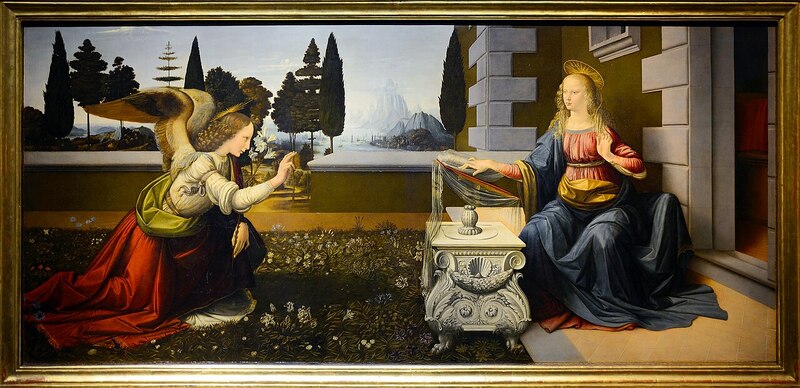
In iconography that tells the Annunciation story, Mary is often shown with her hand lifted toward the angel. Some say it’s a gesture of greeting, but I’ve always seen something else in it—a kind of startled pause, a hand raised as if to say, “Wait a minute… I have plans.” It’s the gesture of someone whose life has just been disrupted, whose future has just been rewritten without warning.
And this is why Luke tells us she is perplexed. Because God’s invitation doesn’t arrive into a blank slate. It arrives into a life already in motion. A life with commitments, hopes, expectations. A life with its own story. And the Annunciation is the moment when Mary discovers that her story—the one she thought she was living—is being gathered up into a much larger one.
Luke tells us that the angel Gabriel greets her with words that must have sounded strange: “Greetings, favoured one. The Lord is with you.” Before Mary does anything—before she responds, before she understands, before she consents—God names her beloved. God names her chosen. God names her favoured.
This is how God always begins. Grace first. Blessing first. Identity before vocation. That is our human story written right from the beginning of creation. It’s easy to forget this. We often imagine that God’s story begins with our effort, our faithfulness, our decisions. But the Annunciation reminds us that God’s story begins with God’s initiative. God speaks first. God blesses first. God calls first.
And Mary’s first task is simply to receive the truth of who she is. Sometimes that is our first task too. But Mary is not passive in this moment. She is not a silent vessel. Luke tells us she is perplexed. She ponders. She asks the most honest question in Scripture: “How can this be?”
I love that question. It’s the question of someone who is awake. Someone who refuses to pretend that impossible things are easy. Someone who knows that God’s invitations often arrive wrapped in disruption.
Mary’s “yes” is not blind obedience. It is courageous discernment. It is the response of someone who knows the cost of saying yes to God. Because this yes will cost her. It will cost her reputation. It will cost her safety. It will cost her the future she had imagined. And yet she asks her question. She considers the invitation. She weighs the risk. And then she chooses. Her agency is real. Her courage is real. Her consent is real.
And that matters for us, because faith does not mean surrendering our agency. It means bringing our whole selves—our questions, our fears, our discernment—into the presence of God. It means trusting that God honours honest wrestling. Sometimes the holiest thing we can say is, “How can this be?”
Then comes the moment that changes everything. Mary says, “Let it be with me according to your word.” And with those words, the Incarnation begins—not in a palace, not in a temple, but in a womb. In hiddenness. In darkness. In the slow, unseen work of growth. God’s salvation begins small.
We sometimes imagine that God’s work must be dramatic or public or impressive. But the Annunciation tells us otherwise. God’s work often begins where no one is looking. In the quiet. In the ordinary. In the places we overlook.
And if that’s true, then perhaps the most important things happening in our lives right now are the things we can’t yet see. The healing that’s just beginning. The courage that’s forming. The reconciliation that’s still underground. The hope that hasn’t yet surfaced.
God loves to work in hidden places. This is the pattern of God’s life with us: beginnings that look like nothing, seeds that take time, grace that grows in the dark.
Mary becomes, in this moment, the first disciple. The first to carry Christ. The first to embody the gospel before it is ever preached. She becomes the one who bears God into the world—not through argument or doctrine or power, but through her own body, her own life, her own willingness to be part of God’s future.
And that is the Church’s calling too. We are not here simply to admire Mary’s courage. We are here to learn from it. To let it shape our own vocation as a community. Because God is still announcing things. God is still speaking into ordinary lives. God is still inviting us into futures we didn’t plan.
Faith is not a static thing. It is not something we simply think or believe. It is something we inhabit. Something we participate in. Something that grows in us, often quietly, often slowly, often in ways we don’t yet understand. The Annunciation is not just Mary’s story. It is the Church’s story. It is our story.
So on this Feast of the Annunciation, in the quiet of a mid‑week Eucharist, I want to ask a gentle question: Where might God be announcing something new in your life? Where is the Spirit whispering an invitation that feels too small to notice—or too big to handle? Where is God asking for your attention, your courage, your willingness to imagine a different future?
Maybe it’s a relationship that needs healing. Maybe it’s a step toward justice you’ve been avoiding. Maybe it’s a call to generosity, or forgiveness, or vulnerability. Maybe it’s simply the invitation to trust that God is with you in the ordinary, the hidden, the unremarkable places.
Whatever it is, Mary’s story tells us this: You don’t have to be extraordinary for God to do extraordinary things through you. You don’t have to have everything figured out. You don’t have to be fearless. You just have to be willing to listen.
Willing to ask your questions. Willing to let God’s future brush against your ordinary life. And when the moment comes—when grace meets courage, when invitation meets response—may you find yourself saying, with Mary, “Let it be.”
So today, may you hear God’s greeting again. May you trust that grace precedes every calling. May you find courage to ask your questions. May you discover that God is already at work in the hidden places of your life. And may the God who began salvation in the quiet of Nazareth begin something new in you.
Amen. +

