
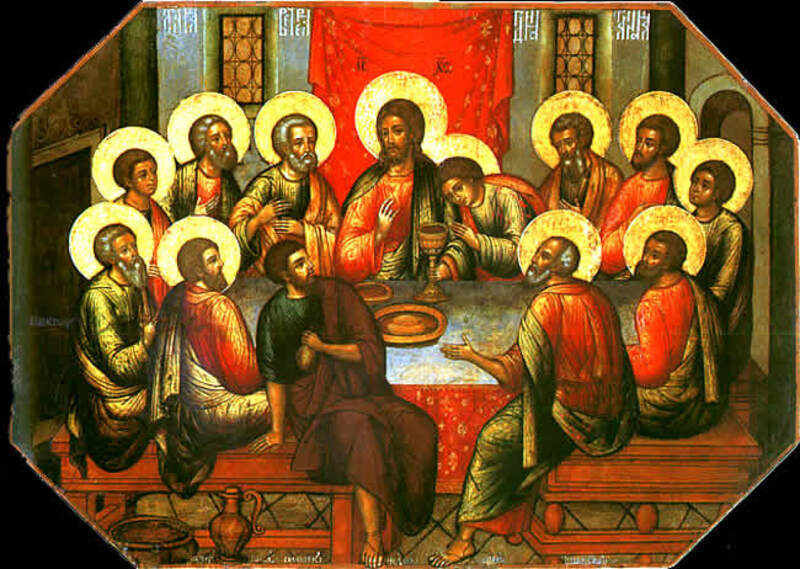
A sermon preached by the Reverend Canon Dr. David Anderson, at St. Jude’s Church, Oakville on April 1, 2026, Holy Wednesday.
Title: ‘When the Cost Becomes Clear.’ Text: Isaiah 50:4–9a; Psalm 70; Hebrews 12:1–3; John 13:21–32.
I speak to you in the + name of Father, Son and Holy Spirit. Amen.
There is a moment in every story when the cost becomes clear. A moment when the path ahead is no longer theoretical, no longer a set of possibilities, but something that must be walked. Holy Wednesday is that moment. The shadows have lengthened. The tension in the room where Jesus has gathered with his disciples for the Last Supper is no longer subtle. And Jesus, who has been teaching, healing, feeding, and forming this community of disciples, now stands at the threshold of betrayal.
John tells us that Jesus is “troubled in spirit” (John 13:21). That matters. We are not watching a detached, unfeeling Messiah glide through Holy Week as though the events were scripted and painless. We are watching someone who loves deeply, who has invested himself in these friends, who has washed their feet with his own hands—and who now names the one who will hand him over. This is the moment when love becomes costly.
And into this moment, the lectionary gives us Isaiah’s servant, the urgent cry of Psalm 70, and the exhortation of the Letter to the Hebrews. Together they form a single, steadying truth: faithfulness is not the absence of suffering; it is the refusal to let suffering define the story.
Isaiah’s Suffering Servant begins with listening: “Morning by morning he wakens—wakens my ear to listen as those who are taught” (Isaiah 50:4b). Before the blows, before the spitting, before the shame, there is listening. The servant’s courage does not come from inner resolve or stoic strength. It comes from a life attuned to God’s voice. A life shaped by the daily practice of receiving words that sustain the weary.
And then the servant says something astonishing: “I gave my back to those who struck me… I did not hide my face” (Isaiah 50:6). This is not passivity. This is not resignation. This is clarity. The servant knows who he is and whose he is. He knows that faithfulness will provoke resistance. He knows that speaking truth in a world invested in falsehood will draw fire. And yet he does not turn back.
The refrain that steadies him is simple: “The Lord God helps me” (Isaiah 50:7, 9). Not “the Lord God prevents suffering.” Not “the Lord God removes all danger.” But “the Lord God helps me”—in it, through it, beyond it.
Holy Wednesday invites us to stand with this servant and ask: What does it mean to be faithful when the cost becomes clear?
Psalm 70 answers with honesty. “O God, make haste to help me” (v. 1). This is not a polished prayer. It is not a prayer crafted for liturgical beauty. It is the prayer of someone who feels the pressure closing in and refuses to pretend otherwise.
The psalmist does not hide fear. Does not hide urgency. Does not hide the longing for God to act now. And perhaps that is part of the gift of Holy Wednesday. It gives us permission to pray without varnish. To name the betrayals we have felt. To name the pressures that make faithfulness costly. To name the places where we, too, are saying, “O God, make haste.”
Jesus knows this terrain. John tells us he is “troubled in spirit” (John 13:1). He is not immune to the sting of betrayal. He is not untouched by the pain of being handed over by someone he has loved. And yet He does not run. He does not hide. He does not let betrayal define him.
Hebrews invites us to look at Jesus through a different lens: “For the joy set before him he endured the cross” (Hebrews 12:2b). Not because the cross was good. Not because suffering is holy. But because Jesus could see beyond the moment. He could see the joy of reconciliation. The joy of a world made whole. The joy of love that refuses to stop at the threshold of death.
Hebrews calls us to run with perseverance (12:1)—not by gritting our teeth, not by pretending everything is fine, but by fixing our eyes on Jesus (12:2a). The Jesus who knows betrayal. The Jesus who knows fear. The Jesus who walks into the darkness with a clarity that comes from knowing who holds him.
Holy Wednesday is the day we watch Jesus step into the story that will save us—not as a victim of chaos, but as the One who has already set his face toward love’s costly completion.
And then John gives us a line that should stop us in our tracks: Jesus says, “Now the Son of Man has been glorified” (21:31b). Now. Not after the resurrection. Not after the cross. Now—at the moment Judas leaves the room.
How can this be glory? In John’s Gospel, glory is not triumph. Glory is revelation. Glory is the moment when the depth of God’s love is made visible. And here, in the dim light of a room where betrayal has just been named, Jesus reveals the kind of love he embodies:
- love that does not retreat from human betrayal
- love that keeps serving even those who will wound it
- love that walks into darkness carrying light
- love that refuses to let sin, fear, or violence have the final word
This is the glory of Holy Wednesday: God’s love is not undone by our failures. God’s purpose is not thwarted by our betrayals. God’s presence is not cancelled by our darkness.
Holy Wednesday speaks to anyone who has ever felt the sting of betrayal or the weight of costly faithfulness. It speaks to communities trying to live truthfully in a world that rewards convenience over courage. It speaks to those who are weary, those who are waiting, those who are praying words from Psalm 70—“Lord, make haste to help us” — and praying those words with urgency.
And it speaks to the church—our church—as we try to live into the way of Jesus with integrity, compassion, and courage. We know what it is to face resistance when we choose inclusion. We know what it is to feel pressure when we name injustice. We know what it is to walk with people through suffering that cannot be fixed quickly. We know what it is to long for God to “make haste” in the face of exhaustion or grief.
Holy Wednesday does not promise that faithfulness will be easy. It promises that we will not walk it alone. Jesus walks ahead of us. The servant walks beside us. The psalmist gives us words when ours fail. Hebrews gives us a horizon beyond the moment. And together they tell us: This, too, is where God’s glory will shine. Not because suffering is good, but because love is stronger. Not because betrayal is holy, but because God refuses to abandon us in the places where we are wounded. Not because the darkness is powerful, but because the light has already begun to break through.
Holy Wednesday invites us to stand in the quiet before the storm and fix our eyes on Jesus. To trust the God who helps. To run with perseverance. To walk into the coming days knowing that even in the darkest moments, glory is already beginning to break through.
And perhaps the question Holy Wednesday leaves with us is this: Where is Jesus inviting us to walk faithfully—even when the cost becomes clear?
+
Image: The Last Supper, 1685, Simon Ushakov, 1626–1686 (painting). The Sergiev Posad State History and Art Museum-Preserve, Moscow.

