
A sermon preached by the Reverend Canon Dr. David Anderson, at St. Jude’s Church, Oakville on Sunday, October 18, 2026, The Twenty-first Sunday after Pentecost. Title: ‘A Word for Beginning and Sending: You are Marked as Christ’s Own.’ Texts: Exodus 33:12-23; Psalm 99; 1 Thessalonians 1:1-10; Matthew 22:15-22.
I speak to you in the name of God: Father, Son, and Holy Spirit. Amen.
There are some Sundays when the lectionary seems to have no idea what is happening in the life of a parish. Then there are Sundays like this one.
Today we celebrate baptisms. We welcome Avaia and Makai into the family of God. Today we bid farewell to our well-beloved Sarah as she begins a new ministry among the people of St George’s, Georgetown. And today our readings speak about identity, calling, and the God who goes with us. At the heart of all our readings is a simple question: whose image do we bear, and whose mission are we called to serve?
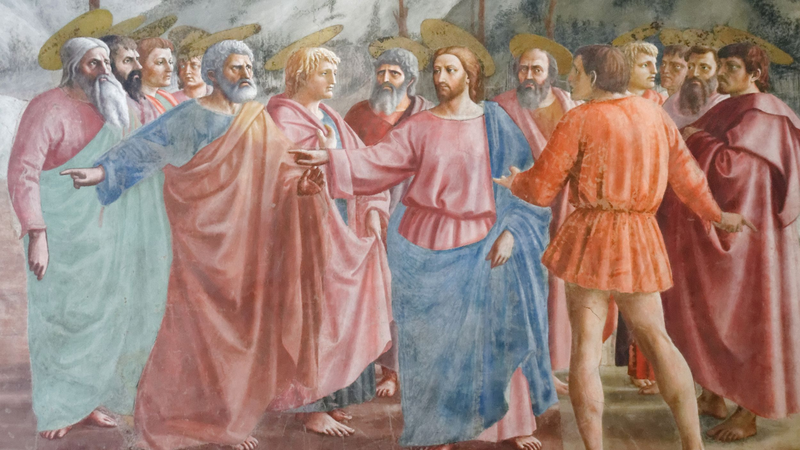
In the Gospel, Jesus is confronted by those who hope to trap him. They bring him a coin and ask whether it is lawful to pay taxes to Caesar. Jesus asks a question in return: “Whose head is this, and whose title?” They answer, “Caesar’s.” Then Jesus replies, “Give therefore to Caesar the things that are Caesar’s, and to God the things that are God’s.”
Often, we focus on taxes and politics when we hear this passage. But notice where Jesus places the emphasis. He points to the image stamped upon the coin. The coin belongs to Caesar because it bears Caesar’s image. Yet beneath the question about taxation is a much deeper question: if coins belong to Caesar because they bear his image, who belongs to God?
The answer reaches back to the opening chapter of Genesis. We do. Human beings are created in the image and likeness of God. The coin bears Caesar’s image; you bear God’s image. The children whom we baptize today bear God’s image. Sarah bears God’s image. Every person gathered in this church bears God’s image. And because we bear God’s image, we belong ultimately not to ourselves, not to the powers of this world, and not even to the roles we occupy, but to God.
That truth lies at the heart of baptism. In a few moments we will gather around the font. Water will be poured and promises will be made. Yet baptism is not primarily about what we do. It is about what God declares about us. God claims us. God marks us as Christ’s own forever. God says, “You are mine.”
Before these children can accomplish anything, achieve anything, or understand anything, God speaks a word of love and belonging. That is where the Christian life begins. Not with our faithfulness, but with God’s faithfulness. Not with our decision, but with God’s gracious claim upon us.
Saint Paul writes to the Thessalonians giving thanks because the gospel came to them not merely in words but in power and in the Holy Spirit. Something happened to them. Their lives were changed. They became witnesses. They became examples to others. The faith they received became a faith they lived.
That is what we pray for every baptized person. We pray not simply that they will be blessed or protected. We pray that they will become a living witness to the gospel. We pray that the Holy Spirit will so inhabit them that they will share in God’s life of love. We pray that God’s image, restored in Christ, will shine more and more brightly through them. The Christian life is never simply about belonging. It is also about being sent.
And that brings us to Sarah.
One of the beautiful things about ministry is that it constantly reminds us that the Church belongs to Christ. Clergy come and go. Congregations change. Seasons change. But Christ remains faithful.
Today we give thanks for Sarah’s ministry among us. We give thanks for her preaching, her pastoral care, her friendship, her prayers, her presence at the altar, and her partnership in the gospel. We give thanks for the many ways God has used her gifts to strengthen and encourage this parish. Yet today is not about an ending. It is a sending.
In our reading from Exodus, Moses is facing an uncertain future. The people are preparing to move forward, and Moses has one overwhelming concern. He says to God, “If your presence will not go, do not carry us up from here.” Moses understands something essential. The success of the journey is not what matters most. The destination is not what matters most. What matters most is the presence of God.
God responds with a promise: “My presence will go with you.”
That promise belongs not only to Moses. It belongs to the whole Church. It belongs to every baptized Christian. It belongs to Sarah as she begins ministry in Georgetown. God’s presence will go with her. There are new faces and new names to learn, new relationships, new challenges, and new opportunities. There will be joys she cannot yet imagine and difficulties she cannot yet foresee. But the God who has called her will not abandon her. The God who has guided her thus far will continue to guide her. God says, “My presence will go with you.”
That same promise belongs to us. Whenever a beloved priest leaves, there can be uncertainty. What happens next? Who will lead us? What changes lie ahead? Yet the answer God gives throughout scripture is remarkably consistent. The future belongs to God. The One who has led us this far will continue to lead us. The One who has sustained this parish will continue to sustain it. The One who has been faithful in the past will be faithful in the future. “My presence will go with you.”
That promise belongs to those whom we baptize this morning. We welcome them this morning at the beginning of a whole life journey that is ahead of them. None of us know what the future holds for them. But we do know this. We know God’s promise of faithfulness: “My presence will go with you.”
Then there is that remarkable moment in Exodus when Moses asks to see God’s glory. It is an audacious request. God responds with both generosity and mystery. Moses cannot see the fullness of God’s glory, yet God allows him to catch a glimpse as he passes by. A glimpse is all he receives, but it is enough. Even a glimpse of God’s glory can transform a life.
Perhaps that is a fitting image for the Christian life. Whether clergy or lay people, whether newly baptized or long-faithful, none of us possesses God’s glory. None of us sees the whole picture. We simply receive a glimpse and then point others toward what we have seen.
That is what Sarah has sought to do among us. That is what parents and godparents, and Christian congregations promise to do in baptism. That is what every Christian is called to do: to bear witness to the God whose glory we have glimpsed in Jesus Christ.
So today we celebrate both beginnings and sendings. We celebrate children being welcomed into the household of faith. We celebrate a priest being sent into a new field of ministry. And we celebrate the truth of who we are: a people who bear God’s image, a people claimed in baptism, a people transformed by grace, and a people sent into the world as witnesses to Christ.
We go forward with confidence because the promise given to Moses remains true. God’s presence goes with us. With these children, Makai and Avaia. With Sarah. With the people of St George’s, Georgetown. With this parish of St. Jude’s. With all who seek to follow Christ.
Thanks be to God. Amen. +

