
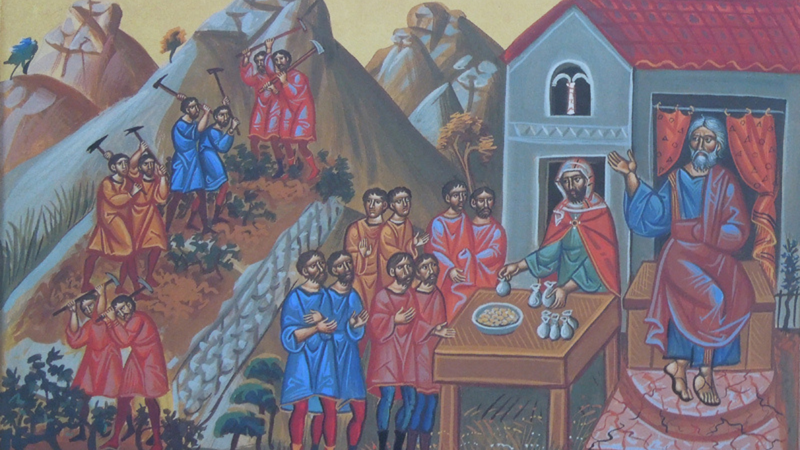
A sermon preached by the Reverend Canon Dr. David Anderson, at St. Jude’s Church, Oakville on Sunday, September 20, 2026, The Seventeenth Sunday after Pentecost. Title: ‘The Generosity We Don’t Expect.’ Texts: Exodus 16:2–15 | Psalm 105:1–6, 37–45 | Philippians 1:21–30 | Matthew 20:1–16.
I speak to you in the name of God, Father, Son, and Holy Spirit. Amen.
There is a pattern in scripture that we see again and again: God meets people not at the moment when their plans succeed, but at the moment when their plans fall apart. It happens in the wilderness. It happens in exile. It happens in prison. It happens in the vineyard, when the workers are convinced that the day has been unfair. It happens in the places where disappointment has stripped away our illusions of control. And it happens in our lives too.
Today’s readings are all about that strange, unsettling generosity of God — the generosity that arrives precisely when we are not expecting it, and often not asking for it.
The wilderness of disappointment (Exodus 16)
The Israelites have barely begun their journey to freedom when they hit their first wall. They are hungry. They are frightened. And they are deeply disappointed. They thought liberation from their slavery in Egypt would feel triumphant. Instead, it feels uncertain.
So they do what human beings do: they complain. They grumble. They imagine that the past was better than it was. They say, “If only we had died in Egypt, where at least we had food.” It is a very human moment.
And it is precisely there — in the disappointment, in the fear, in the collapse of their expectations — that God feeds them. Not with what they wanted. In fact, they didn’t even know what this food was when it arrived. They called it ‘manna,’ which basically can be translated, ‘what is this stuff.; No, it wasn’t what they wanted, but it was what they needed. Not with a return to Egypt, but manna: daily bread, quiet provision, enough for the day.
God’s generosity does not always look like success. Sometimes it looks like sustenance in the wilderness.
The long memory of God (Psalm 105)
Today’s Psalm speaks about the long memory of God. Psalm 105 reminds us that God’s faithfulness stretches across generations. It is not fragile. It is not reactive. It is not dependent on our plans working out.
The psalmist says: “He remembers his covenant forever.” Not “he remembers when things go well.” Not “he remembers when we are strong.” But “he remembers his covenant forever.” Forever — through the wilderness, through the wandering, through the disappointment.
God’s memory is longer than ours. God’s patience is deeper than ours. God’s generosity is steadier than ours.
The generosity that unsettles us (Matthew 20)
Jesus’ parable of the labourers in the vineyard is one of the most unsettling stories he tells. It offends our sense of fairness. It challenges our assumptions about what we deserve. It reminds us that God’s generosity does not follow our rules.
The workers who arrived early expect more. The workers who arrived late expect less. And God gives everyone what they need, not what they expect. Apparently, the kingdom of God is not a meritocracy. It is not a reward system. It is not a spreadsheet of spiritual productivity. It is grace. It is generosity. It is the freedom of God to give as God chooses. And that generosity often arrives in ways that surprise us — sometimes painfully, sometimes beautifully, sometimes both.
A small wilderness of my own
I want to tell you this morning about a small wilderness of my own, because some of you have been asking me about my summer vacation. Some of you may remember that earlier in the summer, just before I started my vacation — I gave a sermon on Psalm 105—the very Psalm we’ve had again today. In that sermon I spoke about my vacation plans to restore my father’s old aluminum boat. I spoke about beginnings, about patient work, about the quiet faithfulness of tending to something that needed care. I imagined restoring that old boat and taking it out on a quiet lake in August.
Well, the truth is: almost none of that happened. I did restore the boat. I painted the hull. I installed navigation and courtesy lights and I restored the woodwork. I put in a bilge pump in and new lithium batteries for the trolling motor. I put a brand-new outboard motor on her. I sat her on a brand-new trailer. And I put a vinyl decal on her side describing her as my “Tin Cathedral.” I did manage to dip her into a northern lake one day. Mostly just putting the boat through the paces. I fished for about an hour and a caught a fish. Great!
But the next night all my fishing gear was all stolen, cutting my trip short. I returned home for a couple days to regroup and just as I was heading out for an abbreviated fishing trip with some gear I cobbled together, just two minutes from home, I was rear-ended in a car accident. The new motor was pushed through the transom of the boat, the hull of the boat twisted, and the trailer was folded in half. All of it: the restored and renewed boat, brand-new motor, and trailer, all destroyed, beyond repair. Everything I had imagined so clearly simply collapsed in a moment.
It was a small wilderness — nothing compared to the great burdens some of you carry — but a wilderness nonetheless. A place where something hoped for was suddenly gone. A place where the summer I imagined simply evaporated. As you might imagine, I was deeply disappointed.
And still sitting in that disappointment, Exodus 16 has come along as a reading for today. The Israelites had expectations too. They had plans. They had hopes. And none of them matched reality.
Yet it was precisely there — in the hunger, in the frustration, in the collapse of their expectations — that God fed them. Not with what they wanted, but with what they needed.
Psalm 105 says, “He remembers his covenant forever.” I needed that reminder this summer. Because God’s faithfulness does not depend on our plans succeeding. It meets us in the wreckage as surely as in the restoration. It meets us in the disappointment as surely as in the triumph. It meets us in the wilderness as surely as in the promised land.
And Jesus’ parable today reminds us that God’s generosity rarely looks the way we expect. Sometimes it arrives in ways that unsettle us, or redirect us, or simply asks us to trust that the story is still being written.
My summer didn’t unfold the way I hoped. But God was faithful in it. And that is enough.
The generosity that holds us (Philippians 1)
Paul writes from prison — another place of collapsed plans. He had hoped to travel, to preach, to build communities. Instead, he is confined, limited, cut off. And yet he says this: “For me, to live is Christ.” Notice, he does not say, “to succeed is Christ,” or “to accomplish is Christ,” or “to complete my plans is Christ.” But simply “to live is Christ” — to be held by Christ in whatever circumstances arise. Paul’s confidence is not in his plans. It is in God’s generosity.
The generosity we don’t expect
The readings today invite us to trust a God whose generosity is not predictable, not symmetrical, not tied to our expectations. A God who feeds us in the wilderness. A God who remembers us across generations. A God who gives us what we need, not what we think we deserve. A God who meets us in disappointment and turns it into a place of grace. This is not the generosity we expect. But it is the generosity we need. And it is the generosity that holds us — in our wildernesses, in our losses, in our surprises, in our hopes, and in all the places where life does not unfold the way we imagined.
God remembers his covenant forever. God remembers you. And God is generous — even, and especially, when we do not expect it.
In the name of the Father, Son, and Holy Spirit. Amen. +

