
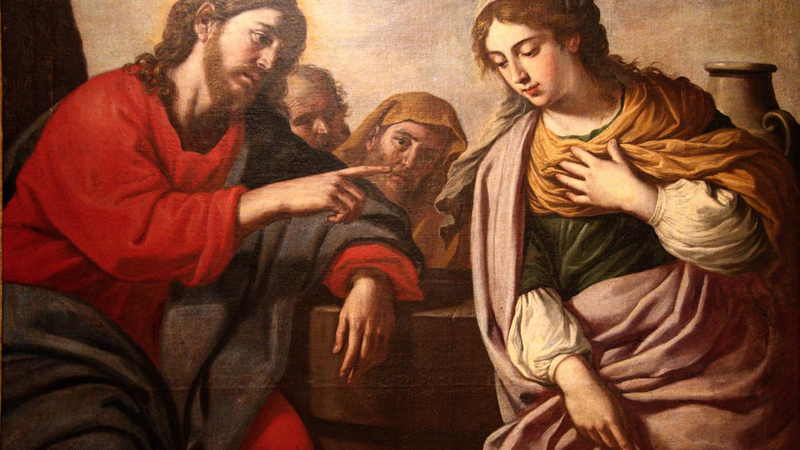
A sermon preached by the Reverend Canon Dr. David Anderson, at St. Jude’s Church, Oakville on Sunday, March 8, 2026, The Third Sunday of Lent.
Title: ‘At the Well: Where Thirst Meets Grace.’ Text: John 4:5–42.
I speak to you in the + name of Father, Son and Holy Spirit. Amen.
As we continue our Lenten journey, we walk again beside Jesus through unfamiliar territory. Lent is often imagined as a season of narrowing—of giving things up, of tightening our focus, of stripping away. But the Gospel readings in these weeks actually do something different. They widen our vision. They show us Jesus stepping across boundaries, opening doors, and revealing a mercy far larger than we imagined.
Last Sunday, we stood with Nicodemus in the quiet of night. Today, we stand in the heat of the noonday sun beside a well in Samaria. And here, in this bright and exposed place, Jesus meets someone whose story has been misunderstood for centuries. A woman whose courage and intelligence become the doorway through which an entire community encounters the Saviour of the world.
As we reflect on this story, may we hear not only what happened then, but what Christ is doing now—among us, in us, and through us.
This is again one of those moments in the Gospel of John when everything slows down. Jesus is tired. He is thirsty. He sits beside a well at noon. And he is in Samaria—a place his people avoided, a place heavy with old wounds and old arguments. Nothing about this moment should lead to a conversation. Nothing about it should lead to a conversion. And yet this is where the gospel opens itself in a new way.
This story is not just about one woman. It is a story about a community learning to welcome those who had been pushed to the edges. It is a story about how the early church learned to breathe across boundaries.
Before anything else happens, Jesus is weary. The Son of God begins this encounter not in strength but in need. That matters. It tells us that the living water he offers is not a prize for the perfect. It is a gift shared in mutuality. It tells us that reconciliation begins not with power, but with honesty.
Jesus asks her for a drink. A simple request. But it crosses every boundary—gender, ethnicity, religion, history. She names the strangeness of it: “How is it that you, a Jew, ask a drink of me, a Samaritan woman?”
She is not timid. She is not silent. She is not ashamed. She is a theologian in her own right. She asks the questions her people have carried for generations.
And Jesus meets her questions with dignity. He does not dismiss her. He does not correct her. He invites her deeper.
What follows is the longest conversation Jesus has with anyone in the Gospel of John (and of course, it makes for a long Gospel reading). This conversation is not with a disciple. Not with a religious leader. It is with a Samaritan woman at a well.
This is not a miracle story. It is a dialogue story. Revelation happens in the give-and-take of an honest conversation. Jesus meets her where she is. She meets him with curiosity and courage. And step by step, her understanding grows. Communication becomes communion.
At first, he is simply “a Jew” to her. Then she calls him “a prophet.” Then she wonders aloud about the Messiah. And finally, Jesus says to her, “I am he.” She becomes the first person in the Gospel of John to hear Jesus speak so plainly about who he is. And she receives that revelation not by sitting quietly, but by engaging him fully.
For generations, the church has read her marital history as moral failure. But we should notice that the text never says that. In the ancient world, women did not choose their marriages. They were widowed, divorced, or passed between households for reasons beyond their control.
Jesus does not shame her. He simply names her reality. And she recognizes in that naming the presence of truth. Her story is not about sin. It is about being seen. And perhaps that is why she stays in the conversation. Jesus sees her whole life without condemnation. He sees her dignity. He sees her intelligence. He sees her longing. And she recognizes in him the presence of God.
She leaves her water jar—the symbol of her daily burden—and runs back to her village. Her testimony is simple: “Come and see a man who told me everything I have ever done.” She does not preach a doctrine. She shares an encounter. And the village listens.
She becomes the first evangelist in the Gospel of John. Her voice carries the gospel into her community. Her testimony opens the door for others to meet Jesus for themselves.
This is how the gospel spreads. Not through coercion. Not through argument. Not by setting up an entertaining worship service. But through the witness of someone who has been transformed by grace. Through the testimony of one who has had an encounter with Jesus.
The villagers first believe because of she has told them. Then they believe because they encounter Jesus directly. This is how faith grows—through testimony, through relationship, through the courage of someone who dares to speak. And then comes the line that changes everything. The people of the village say: “We know that this is truly the Saviour of the world.” Not the Saviour of one people: Jews or Samaritans. Not the Saviour of one tradition. The Saviour of the world. And that confession comes not from Jerusalem. Not from the disciples. But from Samaritans—outsiders who become insiders through the widening grace of God.
When my children were little, they were fascinated by church architecture. They noticed that many churches looked like castles, with piled up bricks and stones, towers, and steeples. They sometimes asked me if princesses lived in these buildings. I wonder what St. Jude’s looks like to some people. To some it might look like a castle or a fortress.
This story invites us to imagine church not as a fortress, but as a well. A place open to the world. A place where strangers meet. A place where living water flows freely. This story invites us to trust that God is already at work in the people we least expect. It invites us to see that the gospel grows whenever someone finds their voice and says, “Come and see.” And it reminds us that Jesus still meets us in our weariness. He still crosses the boundaries we build. He still speaks truth that heals rather than harms. And he still entrusts the work of witness to ordinary people—women, outsiders, those whose stories are complicated, those who carry burdens at noon.
The living water is not a private possession. It is a gift meant to spill over—into communities, into relationships, into places where division has hardened into habit.
At St. Jude’s, we know something about building community across difference. We know what it means to welcome people whose stories are complex. We know what it means to create a place where people can be seen, heard, and loved. This story invites us to deepen that work. It invites us to listen for the voices we have overlooked. It invites us to trust that God is already speaking through people we have not yet learned to hear. It invites us to imagine that the next bearer of living water may be someone standing at the margins—someone who has been carrying a heavy jar in the heat of the day. And it invites us to remember that Jesus meets us not only in our strength, but in our thirst. He meets us in the places where we are tired, where we are uncertain, where we are longing for something more. And in those places, he offers living water—grace that renews, truth that restores, love that crosses every boundary.
At the well, Jesus and the woman create a new kind of community. A community built not on sameness, but on encounter. A community where testimony leads to transformation. A community where the boundaries of belonging are stretched wide enough for the world. May we become such a community. May we meet Christ in our thirst. May we listen for the voices we have overlooked. And may we, like the woman at the well, leave our jars behind and carry living water into the places that need it most.
I would like to bring this sermon to a close by doing something a little different. I invite you now to take a breath … to settle into the quiet of this moment… and to let this story rest with you. Imagine yourself at that well.
Where do you find yourself in this story today?
Are you there beside the well, tired and thirsty, just waiting for someone to notice?
Are you in beside the well already in the middle of a conversation that is stretching you, opening you, revealing something new?
Are you carrying a heavy jar in the heat of the day?
Or are you about to run back toward your community with a story that is too good to keep to yourself?
Let the Spirit show you where you are standing.
Let the living water rise in you—not as an idea, not as a task, but as a gift.
And as we sit in this quiet, listen for the voice that sees you, knows you, and loves you without hesitation. The same voice that met a woman at a well meets us here in this Eucharist today.
Let us pray.
God of living water, meet us in this quiet. Let your Spirit settle over every thirsty place in us. Speak to us as you spoke to the woman at the well—with truth that heals, with love that restores, with grace that crosses every boundary. Draw us toward the life you offer and make us ready to carry that life into the world you love. Amen. +

